

Nuke-like Explosion: US Reveals New Details Of China's Secret Tests
2- 18.02.2026, 8:15
- 7,430
New evidence suggests it really could have been.
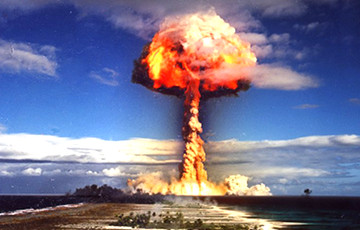
In early February, the U.S. accused China of Beijing's June 2020 nuclear test underground. Now there's new data that says it could indeed have been.
That's according to Reuters.
Assistant U.S. Secretary of State Christopher Yeo said at an event at the Hudson Institute think tank that a remote seismic station in Kazakhstan detected a 2.75-magnitude "explosion". It occurred on June 22, 2020, at the Lop Nor test site in western China, 720 km away.
"I have since examined additional data. There is virtually no basis to say it was anything other than an explosion, a single explosion," Yeoh said, adding that the data was not consistent with mine explosions.
Also he said the explosions were completely inconsistent with an earthquake.
"This is ... what one would expect in a nuclear explosive device test," the assistant secretary of state added.
The Comprehensive Nuclear-Test-Ban Treaty Organization, which is responsible for detecting nuclear explosions, said there was not enough data available to confirm the official's words with certainty.
The PS23 seismic station in Kazakhstan is known to be part of a global monitoring system operated by the Comprehensive Nuclear-Test-Ban Treaty Organization (CTBTO).
The organization's executive secretary Robert Floyd said in a statement that the PS23 station recorded "two very small seismic events" 12 seconds apart on June 22, 2020.
He said the Comprehensive Nuclear Test Ban Organization (CTBTO) monitoring system is capable of detecting "events" that correspond to nuclear test explosions of 551 tons (500 metric tons) of TNT or more.
"These two events occurred at a much lower level. As a result, based on this data alone, it is impossible to assess with certainty the cause of these events," Floyd said.
Yeo argued that China tried to cover up the test by using a method known as "decoupling," in which a device is detonated inside a large underground chamber to reduce the force of shock waves propagating through the surrounding rock.
Reuters added, in like China, the United States has signed but not ratified a nuclear test ban agreement. Under international law, both countries are bound by the agreement.
Reminder, almost at the very beginning of February, the US publicly accused China of a secret nuclear test, claiming that Beijing had violated commitments to ban nuclear tests.
Washington's statement came amid the end of the START-3 treaty, which limited the U.S. and Russian nuclear arsenals, and active attempts by the U.S. side to promote a new, broader nuclear agreement involving China.

Bank's name: Bank Millennium S.A.
Address: ul. Stanislawa Zaryna, 2A, 02-593, Warszawa
IBAN: PL97116022020000000216711123
SWIFT: BIGBPLPW
Name of the account holder: Fundacja “KARTA ‘97”
Purpose/title of payment: Donation for statuary aims
You can contact us by the e-mail [email protected]