

Requiem For An Electric Dream
23- 1.02.2026, 16:06
- 16,422
A logical result of thirty years of gradual degradation of Belarusian science.
The multi-year epic to create a domestic electric car has finally come to an end. Instead of a mass car, the Belarusian Academy of Sciences has decided to limit itself to a tour bus for the Botanical Garden. However, it hasn't been made yet either.
Whether Belarusian officials dream about electric cars and why this dream didn't work out - in the new issue of the program "Optimum" on the YouTube channel "Belarusians and the market".
"We slightly overestimated our capabilities. We did not fully realize that a passenger car is still a lot of security systems, multimedia, and a power frame. And the attempt to integrate their developments into the former gasoline car, unfortunately, did not lead to a good consumer result," President of the Academy of Sciences Vladimir Karanik said in an interview with Belarusian TV on Sunday.
The words "slightly overestimated their capabilities" and "did not lead to a good consumer result," Karanik, of course, flattered a lot. In the sense that the attempt didn't lead to any result at all. Although, it took eight years and tens of millions to properly assess its possibilities.
The first domestic electric car in Belarus was presented back in 2017. It was entrusted to the then First Deputy Prime Minister Vladimir Semashko to test it. He recognized the tests as successful.
"I think that in the next two or three years, it will not just be a toy. It will be a real implementation, so to speak," Semashko said.
But then some minor drawbacks were discovered. The battery for the first Belarusian electric car cost more than the car itself. But the shortcomings were promised to be quickly corrected and from 2021 to start mass production to sell the Belarusian electric car to Belarusians. And not only Belarusians. The Belarusian electric car was going to develop international markets.
The year 2021 was somehow missed, and after that the domestic electric car was promised to be put into serial production every year. Last time it was promised to go into mass production by January 1, 2025. However, then it turned out that, first, not mass production, but only a pilot batch, and second, not January 1, but someday.
As the then Deputy Prime Minister Petr Parkhomchik honestly admitted: "My idea was to take the popular Coolray and make an electric car out of it. And it has turned out. It is there, it has been tested. It should be put into production. But the parts that need to be manufactured require technologies that we don't have yet."
That is, the Belarusian electric car turned out to be too advanced for modern technologies.
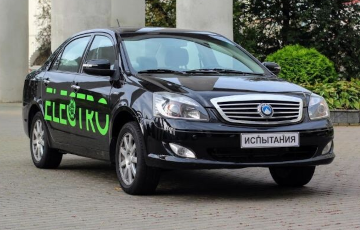
The trial batch, or rather several prototypes, could be produced only by November 2025. As Karanik explained at that time: "They exist, they are in a live copy, they just look like Coolray, cost like Rolls-Royce, and drive like Zhiguli."
Lukashenko was not impressed by these achievements and asked: "So, if I go out and they see me driving this car, will people run away?"
No, Karanik reassured him. There's nothing to worry about. The car is cool.
"They won't run away, it looks like an ordinary Coolray and even drives."
The car that looks like a Coolray, stands like a Rolls-Royce and even drives turned out to be the highest achievement of domestic electric car building.
Four days after the meeting, the SCC accused the development team of misallocating bonuses and inflating prices during procurement.
But, as Vladimir Karanik said, everything was not in vain: "We found our niche. These are special purpose vehicles. Electric vehicles for warehouses, electric cars for airports. This is a tour bus for the Botanical Garden, which is currently being designed and will be manufactured."
That is, it took eight years of effort to create a tour bus for the Botanical Garden. At the same time, even this bus has not yet been made, but is only being designed.
And this failure is not made less epic by the fact that it was predictable from the beginning. It is a natural result of thirty years of gradual degradation of Belarusian science.

Bank's name: Bank Millennium S.A.
Address: ul. Stanislawa Zaryna, 2A, 02-593, Warszawa
IBAN: PL97116022020000000216711123
SWIFT: BIGBPLPW
Name of the account holder: Fundacja “KARTA ‘97”
Purpose/title of payment: Donation for statuary aims
You can contact us by the e-mail [email protected]