

The Fall Of The Kremlin's Chinese Friend
- 28.01.2026, 8:21
- 8,384
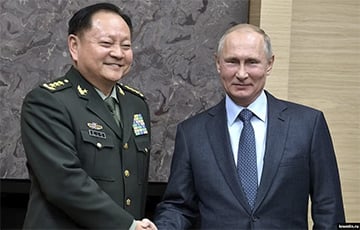
What's behind the arrest of PRC Gen.
China has launched an investigation into Zhang Yuxia, one of the top members of the country's military establishment. The general served as vice chairman of the Central Military Commission (CMC), the top military body of the Chinese Communist Party. Through this position, he played a leading role in deepening China's military partnership with Russia.
Chinese leader Si Jinping's decision to take action against such a high-ranking general has raised serious questions among China's neighbors. They concern Beijing's ambitions for Taiwan, long-term competition with the United States, and China's image as a stable power.
The decision to put Zhang Yuxia under investigation, made public on January 24, left Xi Jinping virtually alone at the top of the country's military hierarchy. Analysts contacted by Radio Free Europe/Radio Liberty say it could have serious implications for the succession of power within the regime. And Beijing's partners and rivals will now be watching particularly closely for possible further changes in the upper echelons of the Chinese Communist Party.
"For decades, China has created an image of a country with long-term plans to expand its influence and rival the United States as a superpower," said Temur Umarov, a fellow at the Carnegie Russia-Eurasia Center in Berlin. - But there are many questions about how much control Xi really has over his inner circle."
Zhang, now under investigation for corruption, was China's most prominent military official.
"He played a central role in dealing with Russia," emphasizes Dennis Wilder, an expert on China's military and former head of China analysis at the CIA.
"Failed to live up to his trust."
China's opaque political system makes it difficult to establish Xi's exact motives. But it is clear that Zhang's arrest came ahead of Xi Jinping's potential meeting with Donald Trump in Beijing in April and during a period of political maneuvering that precedes Chinese leadership reshuffles. Those reshuffles occur every five years, and Xi is expected to seek a fourth term as China's leader in 2027.
According to a statement from China's defense ministry, Zhang Yuxia has been investigated for suspected "serious disciplinary and legal violations." Liu Zhenli another general and chief of staff of the CVC, has also been investigated on similar charges.
An editorial published Jan. 25 in the army's newspaper, the Liberation Army Daily, said Zhang and Liu had "failed to live up to the trust and expectations" of the Communist Party and the CVC and "contributed to political and corruption problems that undermined the party's absolute leadership over the armed forces and jeopardized the foundation of party rule."
The Wall Street Journal newspaper, citing sources familiar with an internal briefing on the allegations, said Zhang was accused of passing information about China's nuclear program to the United States and taking bribes from subordinates in exchange for promotion to top military posts. RFE/RL has not been able to independently confirm this information.
Some experts are skeptical of the intelligence leak allegations. Neil Thomas, of the Center for China Analysis at the Asia Policy Institute, questioned them in a post on X. Thomas questions why a "battle-hardened general" like Zhang would "betray everything that gave meaning to his life for decades" to hand over military secrets to China's main rival.
Like Xi, Zhang, a member of the Party Politburo, is one of China's "princes." That's what descendants of an older generation of revolutionaries and high-ranking party officials are called. Zhang's father fought alongside Xi's father during the Chinese Civil War, which ended with the Communists led by Mao Zedong coming to power in 1949. Both of them subsequently rose to high office.
Zhang is also one of the few Chinese generals with combat experience. He participated in the Sino-Vietnamese conflicts in the 1980s.
The current investigation signifies a new phase of a purge among top Chinese military officials that has been underway in recent years. Some 20 generals were dismissed between 2023 and the fall of 2025. Six of them served in the missile forces.
After these dismissals and the launch of the investigation into Zhang and Liu, only one active officer and two permanent members remain from the CPSC. The third is Xi himself.
"A sense of instability"
The fall of Zhang - China's most powerful general, a Politburo member and one of the few people capable of opposing Xi's plans for succession to power - raises questions about the degree of discontent that exists within the ranks of China's elite. This will certainly be an issue for Beijing's regional partners in Central Asia to ponder. They view China's political system as a model of stability and resilience. "This purge and the sense of instability it causes will occupy the minds of Central Asian leaders," says Temur Umarov.
Zhang has met regularly with leaders around the world, making visits to the United States over the years and interacting with officials from Pakistan to Vietnam. He has also co-chaired the Russian-Chinese intergovernmental commission on military-technical cooperation and has visited Moscow on several occasions for contacts with top Russian officials - most recently in November to meet with Russian Defense Minister Andrey Belousov.
Umarov argues that current events are unlikely to affect security cooperation with China's neighbors, which he says has become "institutionalized" over the years and is carried out at various levels, from policing to prolongation of security activities This adds a new dimension that wasn't there before. China's neighbors will be watching very closely to see how and by whom the vacant seats [in the Central Military Commission] are filled."
Taiwan and the United States are watching closely
The purge in the ranks of China's generals could also have potential implications for neighboring Pacific Rim countries, particularly Taiwan, which China considers its territory.
Analysts say Zhang's ouster could affect China's military readiness and future ambitions for Taiwan. Xi has repeatedly called the island's unification with mainland China "inevitable" and has promised to take Taiwan by force if necessary.
In late 2025, China conducted some of the largest military maneuvers around Taiwan. The PRC regularly sends planes and ships into the airspace and waters around the island to test the resolve of the Taiwanese and their army to defend themselves.
"We will continue to closely monitor abnormal changes in the top echelons of China's party, government and military leadership," Taiwan's Defense Minister Wellington Koo told reporters on Jan. 26. - The fall of any one person is not a reason for us to let our guard down or lower the level of alert we have to maintain."
Drew Thompson, a former Asia strategist at the Pentagon now at the School of International Studies at Nanyang Technological University in Singapore, said the purge could also have policy implications for the United States, which is a major supporter of Taiwan and provides it with vital military support. "For the U.S. deterrence strategy to be effective, we need Xi Jinping to be surrounded by competent generals who will give him objective advice," Thompson notes.
He believes Xi Jinping's actions regarding the CPP "involve operational risks associated with Xi receiving advice and trying to command an army of millions through a one-man committee." "Without Zhang Yuxia in the CPP, the risk of miscalculation increases," the expert adds.

Bank's name: Bank Millennium S.A.
Address: ul. Stanislawa Zaryna, 2A, 02-593, Warszawa
IBAN: PL97116022020000000216711123
SWIFT: BIGBPLPW
Name of the account holder: Fundacja “KARTA ‘97”
Purpose/title of payment: Donation for statuary aims
You can contact us by the e-mail [email protected]