

US Imposes New Duties On 69 Countries
- 1.08.2025, 9:39
- 3,320
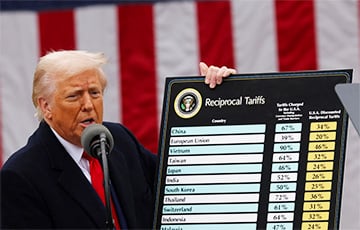
The tariffs, called "refined retaliatory tariffs," will take effect in seven days.
Hours before America's August 1 deadline - the latest deadline set by Donald Trump for new trade agreements with the United States - the American president signed an executive order imposing import duties ranging from 10% to 41% on 69 countries and territories and the European Union, writes BBC.
The duties, which are called "specified retaliatory" in the executive order, will go into effect in seven days, and only against Canada are they effective immediately.
While against Canada, Trump raised the duties from 25% to 35%. However, these duties do not apply to goods covered by the US-Mexico-Canada trade agreement USMCA - these are primarily products made entirely from North American raw materials or products of deep processing from imported raw materials.
The highest duties went to Syria - 41%, as well as Laos and Burma - 40% each. The lowest - 10% - were granted to Britain and its separate Falkland Islands.
The list published by the White House also includes 10% for Brazil, although a day earlier Trump signed an executive order for a 50% duty on imports from that country.
Imports from most of the countries on the list, like those from the European Union, will be subject - unless Trump changes his mind again - to duties of 15 percent.
India, as Trump promised the day before, received 25 percent duties.
In Europe, Switzerland received the highest duties - 39% and Serbia - 35%.
Of all the countries whose imports Trump decided to impose the highest tariffs, only Switzerland is a notable trading partner for the United States: last year it exported $63.4 billion worth of goods to the United States.
China is not on the list: with it, its main trading partner, the United States is in separate negotiations.
A separate paragraph in Trump's executive order is devoted to attempts to avoid high duties by exporting goods to the United States through third countries. Such goods, if their real origin is discovered by U.S. customs, will be subject to a 40 percent duty.
The U.S. Customs and Border Protection Service has already penalized companies importing goods from China for such practices.
Delays and Arrangements
Donald Trump announced large new duties on imports from most U.S. trading partner countries in early April, but then delayed the imposition of those high rates, most recently until Aug. 1.
In the months since, several countries and the European Union have agreed with Trump and his administration to lower import rates on most of their goods:
The UK - from 25% to 10%
Japan - from 25% to 15%
The Philippines - from 20% to 19%
Vietnam - from 46% to 20%
Indonesia - from 32% to 19%
The EU, represented by European Commission chief Ursula von der Leyen, only the other day agreed with Trump on a 15-percent duty (instead of Trump's stated 30 percent) in response to zero duties on U.S. goods in Europe.
Truth is, these are all framework agreements; there are no full-fledged trade pacts yet.
The United States' main trading partner, China, withstood a "tariff auction" in the early weeks when Trump hiked duties on Chinese imports to a prohibitive 145 percent, and waited for the American president himself to lower them to 30 percent in May.
Now Washington and Beijing are negotiating what comes next: a third round was held in Stockholm this week with no results visible to the public.

Bank's name: Bank Millennium S.A.
Address: ul. Stanislawa Zaryna, 2A, 02-593, Warszawa
IBAN: PL97116022020000000216711123
SWIFT: BIGBPLPW
Name of the account holder: Fundacja “KARTA ‘97”
Purpose/title of payment: Donation for statuary aims
You can contact us by the e-mail [email protected]