
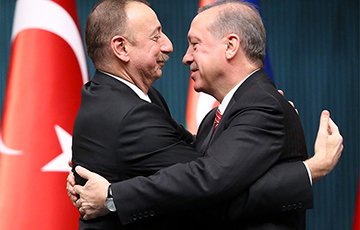
Aliyev And Erdogan Show The Kremlin Who Is The Master In The Region
6- 5.07.2025, 18:23
- 19,362
Russia is losing the South Caucasus.
After a slight weakening of the confrontation between Russia and Azerbaijan on July 3, the conflict only deepened. The very next day, Russia began revoking the citizenship of representatives of the Azerbaijani diaspora. To some, it seems that this is just a clash of ambitions between Ilham Aliyev and Vladimir Putin. But isn't the conflict a reflection of deeper foreign policy processes?
Diaspora is responsible for Aliyev
For many in Russia, it all began with a violent raid against the Azerbaijani diaspora in Yekaterinburg that left two men dead. Azerbaijan, upon receiving their bodies, claimed they had been murdered. However, relations between the two countries have been strained for a long time - after air defense forces shot down an Azerbaijani plane over the capital of Chechnya in late December last year, killing some of its passengers.
Already then, Ilham Aliyev personally commented on the investigation and demanded an official apology, but never received one or normal compensation. It seemed to many, however, that after Azerbaijan officially named Russia as responsible for the deaths, the conflict gradually almost subsided.
The new round that began in Yekaterinburg shows that the confrontation is only deepening. Russian citizens and ethnic Russians in Azerbaijan itself have already become its victims, in addition to the Russian propagandists from Sputnik who were captured by the Azerbaijani authorities. What is this, if not a dispute between two post-Soviet autocrats?
Russia is losing the South Caucasus
To try to assess the real reasons for what is happening, given the fact that neither Russia nor Azerbaijan is commenting honestly on it, we have to remember what has happened in the region over the past five years. During these years, the Kremlin turned from a loyal ally of Armenia into a friend of Azerbaijan, helped or, at least, did not prevent Aliyev from cleansing Nagorno-Karabakh from Armenians with direct military assistance from Turkey and technical assistance from Israel. Then Moscow, Ankara and Baku began demanding that Armenia open the so-called "Zangezur Corridor," a transit route through the south of the country that would connect Turkey and Azerbaijan by land (and thus Russia and Turkey), be under their control, and thus cut Armenians off from their last potential regional military ally, Iran.
The last few months have seen rapid changes. Iran was attacked by Israel and clearly temporarily dropped out of the big geopolitical games. Almost in the same days, Armenian Prime Minister Nikol Pashinyan paid his first-ever state visit to Turkey. Armenia has distanced itself from Russia in the meantime. It seeks security guarantees from the West.
Accordingly, after the new conflict began, Aliyev received a call from Vladimir Zelensky, which was a clear challenge to Putin. The same called French President Emmanuel Macron. France is in violent conflict with Azerbaijan over its support for Armenia and Baku's funding of separatists in its overseas territories. Inside Armenia itself, a fierce struggle with the pro-Russian opposition has begun.
All this clearly shows that the key role in the region is no longer played by Russia, but by Turkey, together with its ally Azerbaijan. Except that in Georgia, Russian influence remains. The Kremlin is gradually losing the South Caucasus, which could be the real reason for the frantic attack on the Azerbaijanis.
What tools does Moscow have to pressure Baku? There is no opposition in Azerbaijan. It is an authoritarian, nationalist regime, built on a rigidly nationalist ressentiment of the return of lost territories. The conflict with Russia will even help it to strengthen.
Economically, the Russian-Azerbaijani trade balance is in Moscow's favor, but the country cannot be said to be directly dependent on Russia. It is rather co-dependent. Back in 2024, Putin discussed with Aliyev schemes that would actually allow the sale of Russian oil and gas under the guise of Azerbaijani oil and gas to avoid sanctions. Moscow has only recently been hit under British sanctions by Azerbaijani businessmen sitting in Rosneft's office and allegedly selling its oil to foreign markets as their own. Hitting such projects is like the Kremlin shooting itself in the foot.
To scare Azerbaijan into war is beyond Russia's power. Its army is bogged down in Ukraine. And Aliyev knows that Turkey is behind him.
It turns out that "bombing Voronezh," that is, hitting the Azerbaijani diaspora, Aliyev-connected purses in Moscow, or just those who send hundreds of millions of dollars to families back home, is the easiest option.
But it does not seem that Aliyev could be frightened by this. It is not known what real financial losses he incurs in this underhanded war, but he is clearly not giving up. After all, the potential gain for him and Turkey is dominance in the South Caucasus.
Ivan Preobrazhensky, "Deutsche Welle"

Bank's name: Bank Millennium S.A.
Address: ul. Stanislawa Zaryna, 2A, 02-593, Warszawa
IBAN: PL97116022020000000216711123
SWIFT: BIGBPLPW
Name of the account holder: Fundacja “KARTA ‘97”
Purpose/title of payment: Donation for statuary aims
You can contact us by the e-mail [email protected]