

Political Scientist: A Truly Independent Belarus Is Possible Only Within The EU
11- 4.12.2025, 16:11
- 4,130
When will the window of opportunity open?
Former political prisoner and opposition blogger Sergei Tikhanovsky has repeatedly voiced the idea of the "Finnish way" for Belarus - "neutral but independent" - in his appeals to Western politicians. Expert of the Finnish Institute of International Relations Grigory Nizhnikov in an interview with "Radio Svaboda" explains why this is unacceptable for our country. We present the interview with small abbreviations.
- Before discussing the modern meaning and relevance of the term "Finlandization" for Belarus, let's remember what this term means for Finns themselves - both historically and now. What was the meaning of this word then and how is it perceived now?
- During the times of the Soviet Union in Finland there was self-censorship and mere censorship on this issue, i.e. it was impossible to criticize the USSR, its policy and relations with Finland. It is not a secret that Finns themselves, especially today, have an extremely negative attitude to this term - they consider it in a certain sense derogatory for Finland.
The main thing is that "Finlandization" is a restriction of sovereignty, which Finns would never voluntarily agree to. Circumstances and time forced them into it. And from today's point of view "Finlandization" meant, roughly speaking, lost time for Finns. For 40 years, they could not do what they wanted to do, either domestically or in the foreign arena. They could not develop as they saw fit.
In a positive sense, the term can only be seen in a positive sense because everything ended well for them in the end. If things had gone badly, if the Soviet Empire had not collapsed, there would have been no Finnish membership in the European Union. And there is no telling how things would have ended in principle.
- Perhaps the negative assessment is a reflection of the present time and events against the background of Russia's aggression against Ukraine? But from the point of view of that time, maybe it was an option that allowed Finland to develop in a certain sense? We saw the economic success of this country, they took cheap Soviet energy resources, sold their products quite profitably to the USSR.
- Finns had no freedom of choice, no other choice but to earn in this way. And if Finland had joined the Marshall Plan, the European Union, the standard of living would have been completely different. The country would have got rid of economic problems much faster.
If you look more closely, from a certain point of view, you can probably find positive sides of "Finlandization". But we have to come back to the main point: this is a state of limited sovereignty. And if there were a choice - to have full sovereignty or limited sovereignty, any nation would choose independence.
Many Finns know how the Finnish elites maneuvered, for example, applying "sauna diplomacy", and take it as a given and a forced necessity. The Soviet-Finnish treaty was signed, under which the two countries essentially formed a defensive alliance. And if, as Stalin hoped, the Communists had come to power, we would be discussing "Finlandization" very differently. We can say that the Finns in a sense were lucky that they retained their sovereignty.
- But let's move on to Belarus. What is the flaw in the concept that Belarus should become a bridge between Russia and the West? At the same time, given the rather strong pro-Russian sentiments and the current dependence on Russia, it is not necessary to join Western structures.
- It is unrealistic. It is impossible to live between two conflicting geopolitical blocs. Besides, Russia will never agree to the "Finlandization" of Belarus. For them Belarus is not Finland, they consider Belarusians to be Russians, and Belarus to be Russian territory. And if someone wants to become a "bridge," then, excuse me, he will find himself under the bridge without a country, without a home and without everything.
- You say that Russia will not agree even to the "Finlandization" of Belarus, that is, to a relatively neutral Belarus. But then Moscow will definitely not agree to Belarus' joining the Western structures.
- Belarus must defend its interests. The main problem is that it will not work with Lukashenko's regime. The main thing for Lukashenko and his regime is power, and under him Belarus loses its sovereignty. Therefore, I think we should forget about any possibilities to do something together with Lukashenko, not even to discuss it.
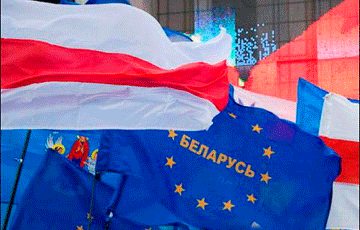
As for those forces and public groups that want to fight for the independence of Belarus, they should realize: a truly independent Belarus is possible only within Europe. Because in the Russian geopolitical project Belarus will be only a Russian region.
I think we need to build a strategy of membership in the European Union and act accordingly. Will Belarus have such a chance? We do not know. But, most likely, it may appear in the future - and we need to work on it. The window of opportunity will open when Russia will have neither energy nor time to deal with the Belarusian issue. If at that moment we discuss whether we should be a new Finland or be neutral, we will only increase Moscow's chances of realizing its plans.

Bank's name: Bank Millennium S.A.
Address: ul. Stanislawa Zaryna, 2A, 02-593, Warszawa
IBAN: PL97116022020000000216711123
SWIFT: BIGBPLPW
Name of the account holder: Fundacja “KARTA ‘97”
Purpose/title of payment: Donation for statuary aims
You can contact us by the e-mail [email protected]