

American Medic From Kalinovsky's Regiment: Belarusians Are Very Strong People
3- 3.12.2025, 14:42
- 6,954
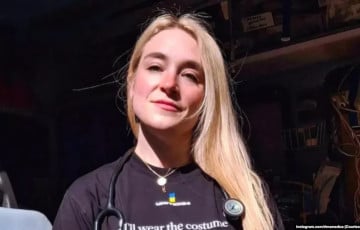
Photo from personal archive
A story about courage, faith, and the purpose of life.
Rima Jiuraitis left her life in the United States to save soldiers in Ukraine. She traded a financial office for the sight of torn limbs and entrails. Sometimes all she wants is a hot shower. But Rima plans to return to civilian life only when the war is over, reports Radye Svaboda.
Now or Never
The Kalinovsky regiment recently presented on its social media pages a combat medic named Stitch (stitch from English means "seam") who serves with them. In civilian life, the woman's name is Rima Ziuraitis (Rima Ziuraitis). She is 37 years old.
Rima lived in the United States until 2022 and worked in the financial industry. After Russia's full-scale invasion of Ukraine began, she quit her job and went to war. She says she made the decision easily: it was now or never.
"There was no hesitation. I knew: this is what I would have to do. And I was very determined. I never had any doubts. Would I do it again? Yes, no hesitation," she says.
The interviewee notes that for her, the war began not in 2022, as it did for many volunteers, but in 2014, when Russia occupied Crimea. Rima is of Lithuanian descent. Her great-grandparents came from Lithuania. She is the granddaughter of World War II war refugees. Rima notices that Russia has invaded her country as well.
Since 2014, the girl became active with the Ukrainian community in the United States, going to rallies to advocate for the preservation of Ukraine's sovereignty. In 2022, she headed a non-governmental organization that provided non-lethal military and medical assistance. About a year later, Rima realized there was a need for medical professionals and decided to radically change her professional field.
"I've always been good with people, helping people. I care a lot about people's health and safety, I took care of my grandmother for many years. So it was a pretty easy transition for me. I fell in love with medicine," she explains of her career change.
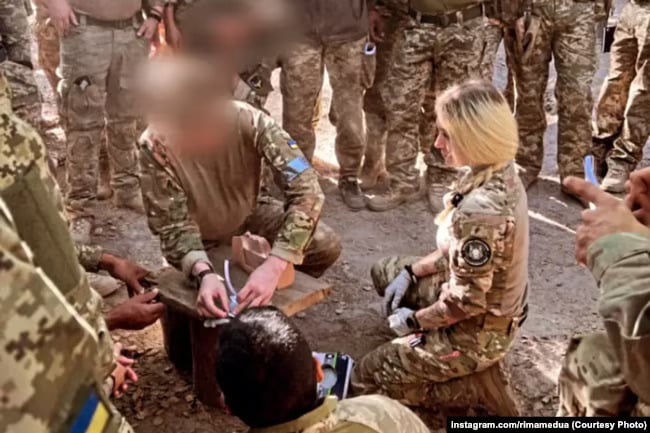
Training to become a combat medic took about eight months - though medics never stop learning, she notes. At first, she worked as a tactical medicine instructor. Now in Kalinowski's regiment, her main job is assistant surgeons and nurses at the stabilization station (something like a hospital). Sometimes she also works on a medevac - a special vehicle that transports the wounded from the battlefield to the stabilization station.
"Enlisted and ended up in Kalinowski's regiment"
Rima had few ties with Belarus before. She got into Kalinovsky's regiment thanks to a friend of hers from Kalinovsky's regiment who had taken one of her medical courses. He said that there was a vacancy for a medic in their unit.
"I signed up and that's how I ended up in Kalinowski's regiment," summarizes the interviewee.
In 2020, Rima participated in the rallies of Belarusians in Chicago against Lukashenko's regime. She says she previously knew several expressions in Belarusian. When asked to remember something, she says, "Zhyve Belarus!"
"The people I protested with are wonderful. And, of course, the people I serve with are also wonderful. I love my team. I deeply respect people who fight for freedom at their own risk. So I have deep respect for the Belarusians I serve with. Strong people. Very strong people," she says.
Rima says she never had a moment in the war when she thought of returning to civilian life.
"I was afraid. If you're not afraid, then there's something wrong. There's always an element of fear in this job. My biggest fear is the problems with FPV drones. They haunt our medical evacuators, stabilization points. The Russians are always finding new ways to prey on people," Rima says honestly.
She says that never, even when there was a lot of artillery working nearby, did she have thoughts of, "Going home, this is too much for me." Instead, her thoughts turned to questions: "What can I do, who can I help, and who needs what?"
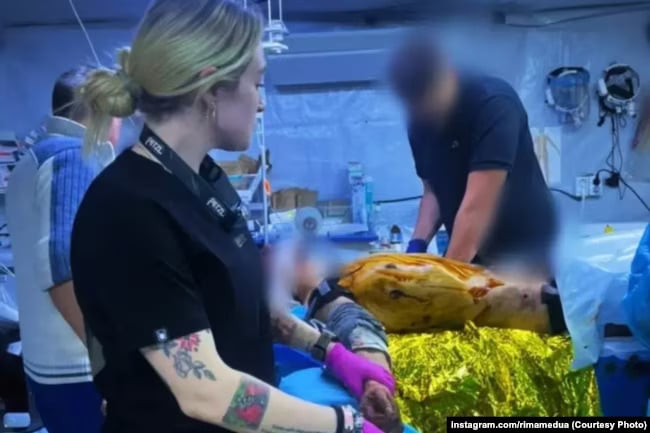
"The hardest thing for me is the suffering of wounded soldiers. It makes me incredibly sad. It's not about physical trauma, it's not about blood and entrails - that's part of my job, it's not something I'm afraid of: it's hard for me to watch people suffer," says the combat medic.
Rima notes that he strives to alleviate their suffering. He also tries to take care of himself in these circumstances.
"It's extremely important to talk to someone, whether it's a therapist or a priest. When you're going through a difficult time, a lot of people get PTSD. I also have soldiers come to me to talk. When you stop talking to people, I think it's less healthy. The basic idea is to always be there for someone when they need you, and when you need someone, find someone you can talk to and trust," she says.
In taking care of herself, Rima also does a lot of journaling.
"It helps to get everything out of your head on paper," she says.
She also continues to do small things she did before the war, such as knitting hats - as a hobby.
First Wounded
Stitch told of her first wounded man. She was on night duty at the stabilization station. A man was brought in in pretty critical condition. It looked like he had stepped on a land mine.
"One leg was completely unrecognizable. The surgeons decided to do a partial amputation. I noticed that the soldier was still awake and was very calm. He didn't scream, they don't usually do that. Those who screamed, we only had a few," recalls the medic.
Rima started talking to the wounded man to let him know he was not alone. Now she does that with other patients, too. Telling them a few phrases in Ukrainian that she knows.
"I asked then: "Are you all right?" He heard me speaking English and asked: "What's your name?" I was shocked. I didn't expect that. I looked at him and said: "My name is Rima." I took his hand. He said: "My name is Alexander." We fixed his legs. But it was a moment I'll never forget because he was so calm and just needed someone to be there for him," she shares.
It's a comfort to people on the worst day of their lives, Rima believes. It's also a comfort to herself that she did something to help someone through a difficult time.
Rima has yet to have a patient die that she has saved. But on several occasions she has encountered soldiers who have already died.
"We process our dead. That moment is always very sad for me, but at the same time I feel relieved because they are no longer suffering. As medics we know we can't save everyone, but we will fight like hell to try and save. So we will always be thinking, could we have done something more, even if nothing can be done," she admits.
On the days when she faces death, Stitch shares, she spends more time in silence, in reflection, thinking about the deceased, their family.
"When we have a situation like this, we try to work a little bit harder for the wounded who come to us that day to make sure it doesn't happen again...I think a lot. I'm always in my head, most of the time. My friends ask, "Where are you?" And I'm just sitting there," she points to her head.
Rima says she cries a lot in the war, in the last week, too.
"I think it's a human reaction, especially when we lose our friends. A lot of my friends have been killed. This experience never gets easier. It still hurts every time," she admits.
"There are days when I just want a hot shower."
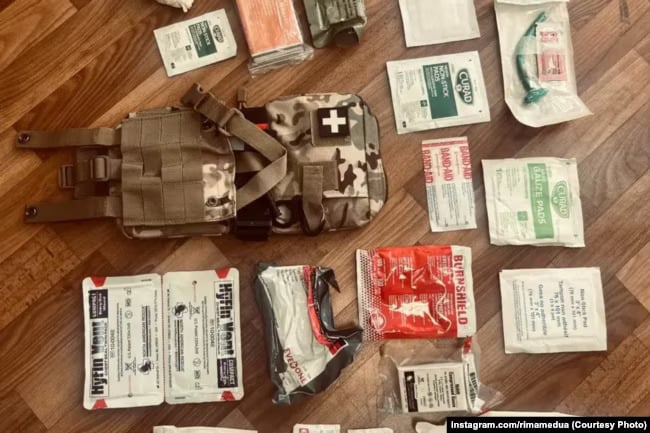
Rima's primary language of communication is English. But she has learned the Ukrainian alphabet so she can read, especially the names of medicines and procedure kits, and already understands a lot of Ukrainian, though she still has difficulty speaking the language.
"I need to be able to recognize these words and their meaning so I can communicate to the surgeons what they asked for," she explains.
Some of the medics on the unit speak English. Rima hears them learning her native language through Duolingo. She learns their native language through the same app.
Staying a woman in war is difficult, Rima says. It depends on where one is and one's role in the war.
"Sometimes in the cities on the front lines there are places where you can go to get a manicure, a haircut. When I get a break, I go to dye my hair. I think it's more because you're a woman in a male-dominated environment. Taking care of yourself is about your priorities. If you make it a priority, you'll find a way to get your nails done, your hair done," she reflects.
She says she looks more often like she did when we spoke, with her braid braided. Goes to get a manicure to relax. Taking care of oneself even in war in this regard is normal, Rima believes.
"If we stop taking care of ourselves, it affects our morale worse," she believes.
She has learned to appreciate running hot water, electricity and comfortable toilets.
"Running water is my favorite thing. I've been through many situations where we didn't have running water and electricity, and the relief I feel once I get to a place that has them is wonderful. Street toilets have no charm whatsoever. There's nothing positive that can be said about a street toilet. But, you know, you deal with it, and that's life. I come from America, where we don't have these problems, but I adapted quickly," she says.
The thought of her mission, and the fact that it won't always be like this, helps her overcome such difficulties.
"You grumble and complain because there are days when - yes - I just want a hot shower. But, you know, it's not forever," says the interviewee.
"Life can be very short."
Rima admits that right now in the war she has no goal of starting a family and raising children, although she doesn't rule out that something could change.
"My goals are a little different now. I'm extremely focused on my work right now. I love my life...We have teammates who are happily married and they love their lives. There are a lot of people who find love. I think that's a wonderful thing. Very supportive of those people. I believe in love. It's important not to miss an opportunity. But for me being a wife and mother is not the main priority now," she notes.
She says she never thought of leaving the war. She thinks of returning to a peaceful life only when Ukraine wins the war. She would like to continue, also in civilian life, to work as a medic, to enter the medical field. Rima doesn't know yet what country she will live in.
"I don't know what the future holds for me, but now I am happy that I am following my dream," she says.
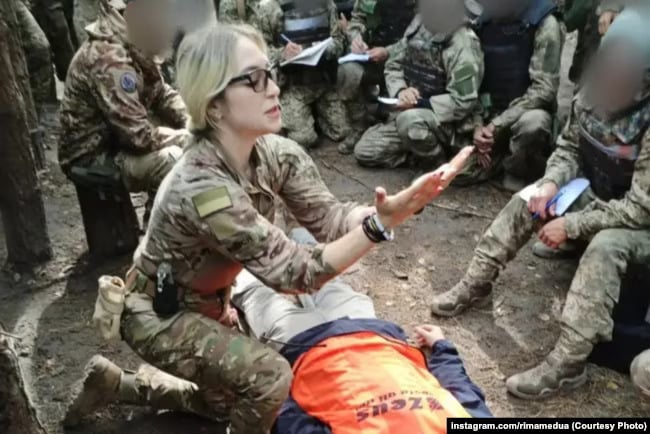
Rima believes that during her time in the war, she has become more confident.
"It's not just fearlessness. It's a lot of confidence in myself, in my abilities, in life. It helped me keep my courage and convictions to stand up for the rights of others. It has given me as an individual a stronger voice. I used to be more afraid of what people might think. Now I just know that it's the right thing to do and it doesn't matter what others think. You need to go after your inspiration, your determination, your goals, what you think is right in life," she believes.
The war has made her stronger and her skin thicker, Rima notes. And has given her the opportunity to be more herself. She says she almost never thinks about how her life would have turned out if she hadn't gone to war.
"I stepped back for a minute to make a sacrifice of service. The life I led was very different. The present life is good for me. So I let go of that past," she says.
She wants other people to continue to support Ukraine and talk about it.
"Don't let anyone forget about us. And one more piece of advice I have: life can be very short. If you have goals in life, but if you're afraid to try something, if you're worried about what others might think, remember that life is short and do your own thing, because you never know when you might not have that opportunity. And always tell people you love them at every opportunity," says Rima.

Bank's name: Bank Millennium S.A.
Address: ul. Stanislawa Zaryna, 2A, 02-593, Warszawa
IBAN: PL97116022020000000216711123
SWIFT: BIGBPLPW
Name of the account holder: Fundacja “KARTA ‘97”
Purpose/title of payment: Donation for statuary aims
You can contact us by the e-mail [email protected]