

Media: Putin's Newest Nuclear Missile Exploded During Testing For The Second Time In A Year
16- 30.11.2025, 10:35
- 7,674
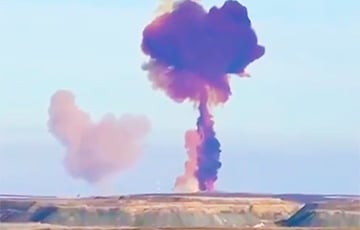
The failure of Sarmat would seriously damage Russia's nuclear strategy.
An explosion at a strategic missile base in the town of Yasny in the Orenburg region Friday afternoon was the result of a failed test of the newest Sarmat nuclear missile, military experts believe, The Moscow Times reported.
The footage captured by eyewitnesses shows the missile flying out of the silo, rising into the air, then lurching, burning and falling, falling apart and leaving behind a giant mushroom-shaped cloud of an orangish-purple hue.
A liquid-fueled intercontinental ballistic missile exploded near Orenburg, and by all accounts it is a Sarmat, according to Pavel Podvig, a senior fellow at the United Nations Institute for Disarmament Research. Russia has been developing this missile since 2013 to replace outdated Soviet land-based missiles. President Vladimir Putin promised that the Sarmat would reach the troops as early as 2020, but the missile never flew. A previous attempt to test it about a year ago ended unsuccessfully: the missile exploded in a silo at the Plesetsk test site, leaving behind a giant crater.
It is most likely that the Sarmat test failed again, agrees Etienne Marcus, a researcher at the French Foundation for Strategic Studies (FRS). The military needs to certify the missile urgently, as Putin announced its appearance in the troops this year, the expert reminds. The missile fell 1 km from the silo, leaving behind a 70-meter crater, Marcus notes, citing Sentinel 2 satellite images.
full video pic.twitter.com/S6FqlopYdF
- MilitaryRussia.Ru (@DnKornev) November 28, 2025
This time the missile was attempted to be launched in the direction of the Kura test site in Kamchatka: for the Yasnoye and Kura areas, Russia has issued NOTAMs - notices to pilots recommending them to avoid dangerous areas, military expert Dmitri Kornev notes.
He agrees that it could have been a Sarmat missile that fell. However, he does not rule out that there was a failed test near Orenburg of the Voyevoda (Satan in NATO classification), the oldest missile Russia has, which has been in service since the 1980s. Both missiles are liquid-fueled, which left a cloud of characteristic color.
Podvig doubts: "Voevoda" was last tested in 2013. According to SIPRI, only 34 such missiles remain in service with the Russian Strategic Missile Forces. While some Voyevoda may be in service, it is highly unlikely that the missile forces decided to launch one of them, Podvig writes.
Wide view pic.twitter.com/pR44uF4nsD
- Etienne Marcuz (@Etienne_Marcuz) November 29, 2025
The Yasny base also hosts the latest Avangard missile systems. However, these missiles use a "hot launch" from the silo, while the video captures a "cold launch," the expert points out. "To all appearances, this is another setback for the Sarmat program. It is extremely unlikely that the missile will be deployed in 2025, as announced by the Russian president earlier this month," the expert concludes.
The failure of the Sarmat "will cause serious damage to Russia's deterrence in the medium term," Marcus writes: "The replacement of the outdated R-36M2 missiles (Voyevoda - TMT), on which a significant portion of Russia's strategic warheads are centered, is being postponed even further, and their maintenance, which was carried out by Ukraine until 2014, remains in question."
In total, according to SIPRI, Russia's strategic nuclear forces have 333 land-based missiles. These are mostly Yars complexes (206 units), including mobile ones, each capable of carrying four 250-kiloton warheads. Russia also has 78 Topol missiles with one 800-kiloton warhead, 12 Avangard complexes, and about three dozen Voyevods. The latter have 10 separable warheads.
In addition, Russia has 192 submarine-launched ballistic missiles (Sineva and Bulava), according to SIPRI data.

Bank's name: Bank Millennium S.A.
Address: ul. Stanislawa Zaryna, 2A, 02-593, Warszawa
IBAN: PL97116022020000000216711123
SWIFT: BIGBPLPW
Name of the account holder: Fundacja “KARTA ‘97”
Purpose/title of payment: Donation for statuary aims
You can contact us by the e-mail [email protected]