


The French Parliament Did Not Pass A Vote Of No Confidence In The Government
- 16.10.2025, 18:07
- 1,158
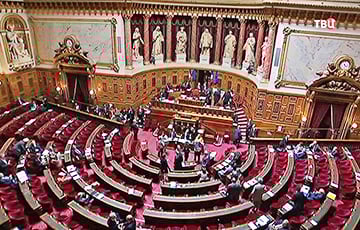
Sébastien Lecornu remains prime minister.
Two votes of no confidence in the government of reappointed Prime Minister Sébastien Lecornu have failed to win a majority in the French parliament. That means the government has held its own, although it cannot rely on a parliamentary majority, writes BBC.
Sebastien Lecornu had to put his new government through two votes of no confidence on Thursday - one initiated by the far-right Rassemblement Nationale party led by Marine Le Pen, the other by the radical left-wing Unconquered France party.
Of the two, the proposal put forward by the radical-left Unruly France party, which was supported by several opposition parties, including Le Pen's party, posed a grave danger to the newly formed government.
A simple majority of 289 votes was needed to force the government to resign. "Marine Le Pen's Rassemblement Nationale and Jean-Luc Melanchon's Unruly France, even with the votes of the other two left-wing parties, did not add up to that many votes. As a result, the proposal of the ultra-left received 271 votes, 18 votes less than they needed.
Along with the radical left and extreme right parties, seven socialists, one member of the "Republicans" party, two independent deputies and one deputy from Guadeloupe voted for Lecornuil's resignation.
The proposal of Le Pen's party also failed to pass - it lacked 145 votes. This result was expected: it is known that the majority of French MPs do not want to openly support the initiative of the far-right.
There is no doubt that the results of the vote of no confidence Lecornu owes to the concessions he made to the Socialists. But Unconquered France is certainly not happy with the Socialists' decision to back the government today.
Unconquered France MP Matilde Panot said she thought first of those who would be affected by the government's "cruel policy" of cutting billions of euros from the social security budget. She accused the Socialists of splitting a left-wing alliance with the Communists and Greens, and told reporters that her party would now put forward a motion to impeach the president, even though it had no chance of success.
After last year's elections, no party has an absolute majority in the National Assembly. The country has had three prime ministers resign in just over a year, all of them center-right.
Sebastien Lecornu's first government formally lasted only 14 hours and collapsed on Oct. 6. But four days later, last Friday, President Emmanuel Macron suddenly reappointed Lecornuil, who had previously said openly on national television that he did not want to continue to lead the government, as prime minister.
But by Sunday, Lecornuil had announced the composition of his second government, and on Tuesday he addressed parliament. This strengthened his position to a certain extent: moderate socialists said they were not ready to vote for a vote of no confidence, and some leading center-right MPs said that now was not the time to change the government, but to try to pass the budget.
Budget, public debt and pension reform are the main issues on which parliament has been unable to reach an agreement with the government for the second year.
Lecornuil's first and most important task, by his own admission, is to get parliament to approve France's 2026 budget.
Two days ago, Lecornuil told MPs that he would suspend one of Macron's landmark reforms - raising the retirement age from 62 to 64 - until the next presidential election in 2027. For the Socialists, or at least most of them, that was enough to win their support, even if it displeased many of Macron's allies, as well as a number of deputies from center-right parties.
The budget will now have to be reconciled through cuts to other items, a process that will not add to the prime minister's popularity among deputies. Each decision will have to be carried through the parliament with a creak, making temporary alliances with one party or another, and this is unlikely to make the work of the second government of Lecornu more effective.
There is no agreement on the new government and its future policy not only in the parliament, but also in society.
For example, a poll by BFMTV shows that 56% oppose any vote of no confidence, which indicates a desire for stability, and 58% consider the suspension of pension reform until the next presidential election as good news.
A poll by the conservative newspaper Le Figaro, however, shows that 62% disapprove of the reappointment of Sebastien Lecornu as prime minister.
This contrast reflects a mixed mood: while people are keen to avoid further political upheaval, confidence in the new leadership remains low and fragmented.

Bank's name: Bank Millennium S.A.
Address: ul. Stanislawa Zaryna, 2A, 02-593, Warszawa
IBAN: PL97116022020000000216711123
SWIFT: BIGBPLPW
Name of the account holder: Fundacja “KARTA ‘97”
Purpose/title of payment: Donation for statuary aims
You can contact us by the e-mail [email protected]