Yuri Felshtinsky: Lukashenko's Regime Can Be Easily Changed
15- 25.10.2025, 22:01
- 21,820
Why Belarus is so important for Europe's security.
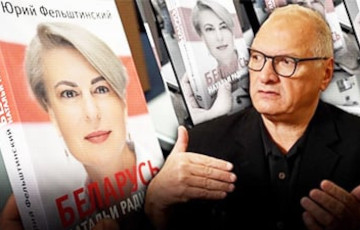
Regime change in Belarus is one of the two elements that can stop Russia's war against Ukraine. This is the opinion of well-known historian and writer Yuri Felshtinsky, who recently released a new book "Natalia Radina's Belarus: Journalist vs. Dictator".
Why is Belarus so important for Europe's security? How can the liberation of our country trigger the collapse of the Russian empire? Yuri Felshtinsky talked about this and more in the program "Prosvet" by Sergei Pelesa on the TV channel "Belsat".The website Charter97.org cites a transcript of the conversation.
- How do you see the role and place of Belarus in the conflict that now continues between Russia and Ukraine, if more broadly - Russia and the West?
- Here, perhaps, we need to break the question into two parts. One side of the coin is the concrete participation of Belarus in the Russian aggression against Ukraine. And now, it seems that Belarus is already at the beginning of the first hybrid stage of participation in the forthcoming aggression against Europe.
Belarus, unfortunately, because of the fact that power in this country was seized by Lukashenko, has really become a vassal, ally of the Russian Federation. It is clear that Belarus is a classical dictatorship, which makes things a bit easier, because a classical dictatorship always collapses with the departure of the dictator. Nevertheless, today Belarus is Russia's ally in the global war against the civilized world, first of all against Europe.
Ukraine is a part of Europe. There is a geopolitical question. If you look at the map, it is clear that Belarus is the gate through which the civilized world either trades with Russia, for example, or it is the gate through which Russia invades Europe. Those who control Belarus - if they are evil forces, as is happening today - have the ability through that control to threaten European civilization, including Ukraine. Or, if these forces controlling Belarus are good forces, then through them, respectively, transit between civilized Europe and Russia is carried out. Therefore, Belarus is the most important geopolitical and strategic territory. Whoever controls Belarus controls Russia's security.
Ideally, as it seemed to us, as we all hoped, Belarus could become a part of civilized Europe. Eventually join the European Union, maybe, in terms of ensuring its security and comfort related to security, join NATO. And, in fact, to close for ever the possibility of Russian invasion of Europe. Because without capturing Belarus, without capturing this buffer zone, Russia cannot threaten Europe.
Belarus is a very important buffer in this respect. And now, when the war has already started, after Russia invaded Ukraine from Belarus in 2022, the importance and significance of Belarus in this issue, I think, has become obvious to everyone. And since we have the task to stop this war, it is important to raise the question of how it can be stopped.
It can be stopped, of course, by changing the regime in Russia. But this task is difficult. Russia is a powerful power with nuclear weapons, with minerals, with oil, with gas, which it successfully sells on the market and uses the money earned to pay for the war. Therefore, it is difficult to stop Russia, with the state security in the form of the FSB controlling the country. It is a difficult task. From a practical point of view, we need to raise the question of how to isolate Russia from civilized Europe. Change it so that Russia will no longer be able to threaten Europe in some foreseeable future (and who knows, there may be regime change).
The easiest possibility is to change the regime in Belarus. Unlike regime change in Russia, which is a noble, important and necessary, but difficult task, it is quite easy to change the regime in Belarus, where we have a classical dictatorship. You just need to set yourself this task. Since Russia cannot win in Ukraine, and we can see it, Russia can destroy Ukraine, Russia can strike every day at Kiev and other major cities.
It is necessary to strike at Moscow and ensure regime change in Belarus. Through these two components of victory, the war stops. And it stops quite quickly, as it seems to me.
- You see, 30 years have passed. Belarusians cannot change the regime in Belarus. There are problems with it.
- The former Soviet republics - Lithuania, Estonia, Latvia - former countries of the Eastern bloc, realized the threat, took advantage of the window of opportunity and joined NATO. Those states that did not want to, did not have time to do it, tried to maintain good relations with Russia, focusing on Russia as a serious sales market and vice versa, as a market for raw materials, were either captured or attacked.
This is Georgia, as we know, which was attacked in 2008, and now, although all Georgian people are in favor of the European Union and against the orientation towards Russia, they cannot throw off the government, because it is supported and financed by the Russian Federation.
This is Moldova, where Russian troops have been stationed since the Yeltsin times. Transnistria, where pro-Russian sentiments are artificially supported, where there are constant attempts by the Russian leadership to carry out coups d'état, to install a pro-Russian government.
This is Belarus, which, unfortunately, thanks to the cunning, treachery of Lukashenko, was essentially occupied by the Russian Federation.
Ukraine also did not have time to join NATO. So this issue is, I think, obvious. In order to ensure the security of small European states, they have to join some serious military and political bloc. Unfortunately, after Trump's arrival, I think the US participation in NATO is no longer worth counting on. That is, America is no longer in NATO. NATO does exist, but I would certainly not count on the Alliance now.
It does not follow from this that opportunities for Russia to successfully occupy Europe are opening up. I believe that time is working against Russia in this case. And that even a de facto withdrawal of the United States from NATO does not make Putin's task much easier. Europe is bristling, Europe is arming itself, Europe has allocated serious budgets for armaments, Europe has realized the level of threat from the Russian Federation.
This is a battle Putin has lost. Another thing is that he does not know about it yet, he is not ready and unable to accept it. Because Putin always underestimates his opponents. He underestimated Ukraine, as we all know. He underestimated Europe's determination to resist Russian aggression. He thought that everyone would capitulate, everyone would be scared and he would march victoriously to Berlin and beyond. In fact, Putin lost that battle. Even Trump has failed to help him in this. Although he is still pushing and pushing Ukraine to make Kiev capitulate. He doesn't know how to help Lukashenko anymore. He is already lifting sanctions on Belarus. Already trying to break Putin's isolation by inviting him to Alaska. But even Trump won't help Putin. Unfortunately, Putin will do the bloodletting. But he will not win.
- For two centuries, of all the modern nations that were born on the soil of the Polish-Lithuanian Commonwealth, only the Belarusians have not managed to break free from Russian domination. Although there have been quite a few attempts. Is it realistic in the future?
- The collapse of the Russian Federation is still to come. I do not belong to historians, politicians, analysts who believe that the Russian Federation will collapse into 20, 30, 50 states. I do not believe in such a scenario, I do not see such a scenario. But the fact that Russia, or rather the Soviet Union, did not disintegrate in '91 is certainly true. And some other territories will certainly depart from the Russian Federation at the next rift, Belarus will be among them. Not only Belarus. Chechnya will secede, Dagestan will secede, Ingushetia will secede, Tatarstan will secede. Many regions and autonomous republics will secede from the Russian Federation on the national principle, including Belarus. This will be at the next historical stage.
It will certainly happen if there is a big war in Europe. So far, everything is heading towards that, as we do not see Russia's failures in the war in Ukraine leading to a reassessment of Russia's plans for foreign policy expansion. Russia is tuckered out in Ukraine. It expected to take over Ukraine in 3 days, but this war is in its 4th year. If this war lasts until January 26th (most likely it will), it will already last longer than the Great Patriotic War of the Soviet Union.
Russia is stalling in Ukraine, but this does not lead to a change in the foreign policy ambitions of the Russian state. That said, Putin doesn't have much time because he has as much time to implement these plans as Trump will have in the White House.
Putin has just over three years to implement his program. After that, there will be a change of leadership in America and hopefully America will return to the family of civilized nations. As long as Trump is in the White House, we should unfortunately forget about America. Europe, Ukraine, democratic Belarus will not receive any help from the United States. Rather, on the contrary, we see Trump helping Putin, helping Lukashenko, helping all other opponents of Ukraine, for example, Orban in Hungary. This is the data we are dealing with, and it should be understood that there will be no change in Trump's policies and behavior.
- A year after our revolution, the migration crisis began, that is, the attack of migrants on the territories of NATO states. A year and a half after the revolution, an open aggression against Ukraine using the territory of Belarus began. In recent days there was a very big wave of flights of weather probes with smuggled cigarettes from the territory of Belarus. Lithuania closed border checkpoints, there was chaos at Vilnius airport. Saboteurs appear in Lithuania and in Poland. How do you see the prospect of this happening? What could be the next steps of the Kremlin regime using Belarus?
- Two directions have already been outlined some time ago. First, all preparations have been made for the transfer of nuclear weapons to Belarus. And even at some point it was believed that it had already been transferred. It is true that the general opinion of people following this is that there are no Russian nuclear weapons in Belarus at the moment. Either because Russia does not trust Lukashenko in this matter, or because Ukraine might have tried to seize these weapons and protect itself from a possible strike from Belarus.
We remember how Lukashenko brazenly and audaciously threatened Lithuania and Poland that he would launch a nuclear strike against these very countries. So this threat is already outlined.
Secondly, we have just witnessed the escalation of the situation because of the alleged Russian-Belarusian exercises. And they were announced as grandiose, with the participation of a hundred thousand servicemen. We remember very well, of course, what these so-called exercises led to in 2022. Therefore, it was obvious that if Russia started to concentrate its troops in Belarus against the background of the war under the pretext of exercises, it would most likely be preparing an invasion. Accordingly, either an invasion of Eastern Europe or the preparation of a second offensive against Kiev.
But in the end, as we know, these exercises were not actually carried out. Either Russia was afraid that Ukraine would launch a preemptive strike against the troops concentrated in Belarus, or because Russia didn't really have enough troops for that. This grandiose hundred-thousand-strong exercise was reduced to an exercise with 13,000 troops.
So not everything is going smoothly for Putin, but nevertheless Belarus as a springboard for a threat is maintained. You have listed correctly now sabotage, saboteurs, drones, and many other things that are still waiting for Eastern Europe, those countries that border with Belarus, because Belarus is left by Putin as a springboard for threat and for attacking Europe. As long as Russia controls Belarus, it will retain this bridgehead. Because if Russia loses this bridgehead and has no opportunity to threaten Europe from Belarus, it loses the war.
- You often say in your comments that Belarus is occupied by Russia. And how to get rid of this occupation? Is it only as a result of a scenario of a big war in Europe? Or is there some other option, let's say Russia's defeat in the war with Ukraine?
- Everyone had the task to stop the war in Ukraine, I don't even want to say that the task is to achieve Russia's defeat in Ukraine. This, unfortunately, is not the case. Europe is to blame, the United States is to blame. No one had a mission to ensure Russia's defeat in this war. Everyone had the attitude to make sure that Russia did not win this war, and Ukraine did not lose this war. And so, unfortunately, this war has been brought to the point where it is already in its fourth year, and then Trump came to the White House, and Putin has a very important ally.
This war should have been stopped in 2022, and there were many tools to do this. But now it turns out that in order for this war to stop, it is necessary, I emphasize, to change the tactics and strategy of this war.
It is necessary to agree that Ukraine should be given weapons to be able to strike Moscow, because Putin does not care about anything but Moscow. Russia is a country of one city. The war is going on for the fourth year, and Moscow does not feel this war at all, on the contrary, Moscow is only getting fat on this war. The number of millionaires increases from year to year, and Moscow feels great on the background of the war, so as long as Moscow does not feel this war, nothing will happen.
And secondly, since we really, probably, now we can no longer raise the question of regime change in Russia (it is very naive to think that this is an easy task that can be quickly solved), it is necessary to raise the question of isolating Russia. And in order to isolate Russia, it is necessary for it to lose control over Belarus. And for Russia to lose control over Belarus, it is necessary to change the regime in Belarus. Because there is a classic dictatorial regime there, which is easy to change. I emphasize - unlike the regime in Russia, where the FSB has seized power as a department that strictly controls this country.
The fact that Belarusians are oriented to the West, not to the East, frankly speaking, was opened to me by Natalia Radina, whom I have known for a long time. The idea of the book that I have recently published, which is called "Natalia Radina's Belarus", was suggested by Natalia when she gave a lecture at one of the Forums of Free Russia, where we spoke together, for uninformed people who did not fully understand what Belarus is. And after her speech, I finally realized that my view of Belarus was absolutely wrong. Belarus has never been oriented to Russia, Belarus has always been oriented to the West, to Europe, felt itself a part of Europe. Because of the fact that no one in Europe had such a view of them, Belarusians have never been helped, although there have been a lot of revolutions in Belarus since 1991. And there were a lot of attempts to ensure the victory of democracy in Belarus. But a small country is not able to solve these issues without the support of Europe.
- The book is called "Natalia Radina's Belarus: a journalist against a dictator". I think it will be a good emphasis to conclude our conversation. Remind me about this book. Thanks to it we met you.
- You are lucky that you have only one dictator. Let's hope his days are numbered. I hope readers will enjoy the book very much. It tells very properly what has been happening in Belarus since 1991. This is a book about Belarus through the life story of Natalia Radina.
Buy the book "Natalia Radina's Belarus: journalist against the dictator" can be purchased at the following sites:
Through the website of the publishing house "ISIA Media".
In Ukrainian you can through the website of the publishing house "Drukarskiy Dvir Oleg Fedorov".
In the near future the book will be published in Belarusian and English.

Bank's name: Bank Millennium S.A.
Address: ul. Stanislawa Zaryna, 2A, 02-593, Warszawa
IBAN: PL97116022020000000216711123
SWIFT: BIGBPLPW
Name of the account holder: Fundacja “KARTA ‘97”
Purpose/title of payment: Donation for statuary aims
You can contact us by the e-mail [email protected]